

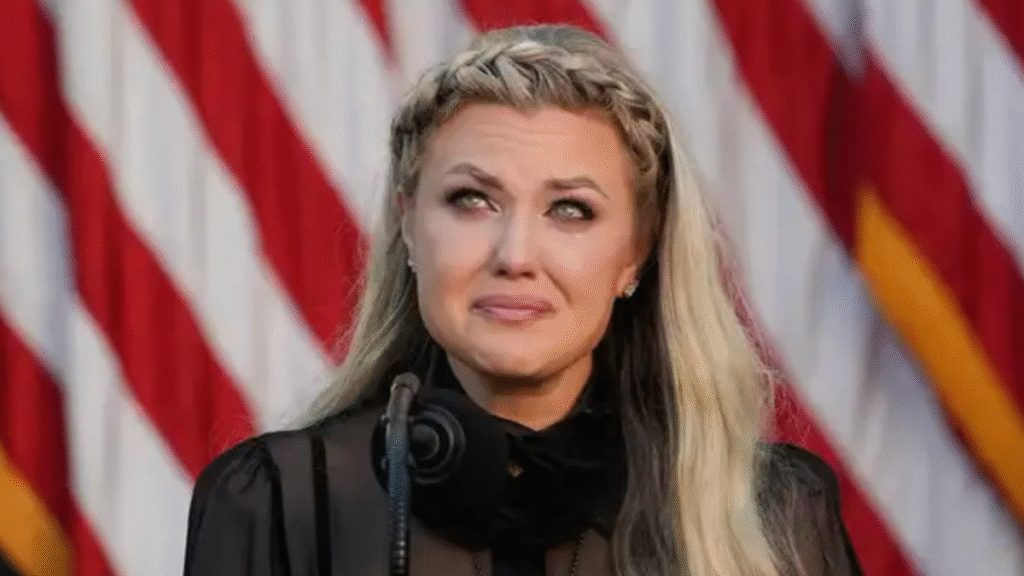
Photo Credit: AP
Erika Kirk Faces Backlash After High-Profile TPUSA Events
In recent weeks, Erika Kirk — widow of conservative activist Charlie Kirk and newly appointed CEO of Turning Point USA (TPUSA) — has found herself at the center of a growing wave of online criticism following several high-profile public events. The strongest reactions appeared after a TPUSA gathering where a video clip went viral showing Kirk enthusiastically interacting with supporters — handing out branded merchandise amidst cheers. Some critics argued that the moment crossed a line between leadership and spectacle, suggesting that her presence at the event appeared more promotional than mourning, given the tragic circumstances surrounding her husband’s assassination in September 2025. The clip sparked discussions on social media about whether she was honoring Charlie Kirk’s legacy or using the platform for self-promotion.
But the backlash wasn’t limited just to that one moment. On social media, users have assailed Kirk on a range of fronts — from the optics of her appearances to assumptions about her intentions. Many of the critical comments conflated personal grief with organizational leadership, questioning her actions as CEO of TPUSA and her public demeanor in the months since her husband’s death. Some labeled her responses “inappropriate,” while others went further, tying their criticism to broader debates about political loyalty, gender roles, and how public figures should behave under intense scrutiny.
Despite the backlash, supporters have also rallied behind Kirk, defending her as a resilient leader and emphasizing that there is no single “correct” way to grieve or carry forward a legacy. Central to this controversy is the broader context of the organization she now leads: a politically influential nonprofit focused on conservative ideas and campus activism, originally founded by her late husband.
The Instagram Response: Erika Stands Her Ground
As criticism mounted following the TPUSA event, Erika Kirk responded publicly in an Instagram post that drew significant attention. On Tuesday, she addressed what she described as “words, accusations, assumptions, and slander,” adding that none of it “lands” or “burns” her. While many figures in politics might shy away from engaging critics directly, Kirk chose a more confrontational and assertive tone, asserting that she “owes the world nothing.” In her post, she also shared personal details about her ongoing process of grieving — like keeping her husband’s belongings in their home untouched — explaining that her private life should not be fodder for public judgment.
Her message conveyed frustration with being scrutinized for how she balances personal grief and her role as a public figure. By emphasizing that she has been judged for her choices — from what remains in her home to how she carries herself publicly — Kirk underscored a common struggle faced by individuals thrust into a spotlight: where private pain meets public perception. Many observers noted that her response mirrored broader conversations about social media culture, where even deeply personal behavior can be weaponized or misinterpreted.
At the heart of her statement was an insistence on agency — that she is not beholden to public expectations about how grief should look or how a leader should behave. Her rebuttal swiftly circulated on platforms like X (formerly Twitter), prompting renewed debate over public etiquette, gender norms, and the pressure placed on people who are both grieving and in positions of influence.
Political and Cultural Backdrop: TPUSA’s Leadership Transition
To understand the intensity of the reactions Erika Kirk has faced, it helps to see the bigger picture around Turning Point USA and its role in American politics. Founded in 2012 by Charlie Kirk and Bill Montgomery, TPUSA is a nonprofit organization that advocates conservative principles on college and high school campuses nationwide, making it a key incubator for young conservative activists. After Charlie Kirk’s assassination at a Utah Valley University event in September 2025, Erika Kirk was unanimously named the organization’s CEO — a significant leadership transition under tragic circumstances.
Since taking over, Erika has been tasked not only with advancing TPUSA’s mission but also protecting and expanding her late husband’s influence in conservative circles. This includes leading campus tours, hosting events, and engaging with a base that sees TPUSA as a meaningful platform for shaping political ideas. In that sense, her visibility is not just personal; it’s fundamentally aligned with her new role.
However, TPUSA’s position within the broader conservative movement is not universally supported — even within the right. Figures like conservative commentator Candace Owens have publicly questioned Kirk’s handling of leadership and direction, critiquing her responses to conspiracy theories and her broader strategy for the organization. These exchanges have further fed into narratives on both sides of the debate, feeding online commentary and sometimes harsher criticism.
All of this unfolds against a backdrop of deepening ideological polarization in the U.S., where public figures — especially in politics — are scrutinized not only for policy but for body language, public appearances, and social media posts. For Erika Kirk, a woman now carrying forward a political legacy while navigating personal tragedy, this dynamic has made every action prone to layered interpretation.
Grief, Leadership, and Public Perception
What’s particularly notable about the criticism surrounding Erika Kirk is how closely it intertwines grief with leadership expectations — an overlap that is uncommon for most public figures. Kirk’s experiences raise questions about how society perceives grief when expressed by someone in the public eye and how those norms intersect with evaluations of leadership capability. Even reactions to her handing out merchandise at a TPUSA event — which might be seen as harmless or routine in a political rally context — became a battleground for debates about authenticity and intent.
Some of the backlash reflects a broader tendency in modern public discourse to conflate personal vulnerability with perceived weakness, especially for women in leadership. Critics have gone beyond standard political disagreement, suggesting that Kirk’s visible engagement with crowds and high energy — emotional responses that might be human in other circumstances — represent some form of opportunism. This blend of personal and political critique highlights the unique pressures faced by high-profile leaders who are also grieving family members. Outside observers have pointed out that such attacks unfairly criminalize normal behavior for those in painful circumstances.
At the same time, remarks supporting Kirk — both in her social media response and in broader commentary — often point out that there is no single “correct” way to grieve and no standard template for how leaders must behave. Rather than diminishing her credibility, supporters argue that Kirk’s visibility and active engagement may be a natural extension of how she is honoring her husband’s legacy while fulfilling her role as CEO.
In this way, Erika Kirk’s situation becomes less about individual choices and more about how public perception is shaped by cultural expectations — particularly in a media environment where every gesture can be amplified, critiqued, and replayed out of context.
Moving Forward: What This Means for TPUSA and Public Discourse
The controversy surrounding Erika Kirk’s recent activities and responses underscores a larger conversation about leadership, loss, and public engagement in a hyper-connected world. For TPUSA, this moment represents both a challenge and an opportunity. On the one hand, critics — both internal and external — are holding Kirk to rigorous standards, dissecting everything she does through political, personal, and cultural lenses. On the other, supporters remain steadfast, asserting that her continued public presence and active role demonstrate resilience and commitment to advancing TPUSA’s mission.
Beyond organizational politics, Kirk’s experience reflects how public figures — especially those connected to emotional or tragic narratives — are subject to intense scrutiny that extends far beyond policy or leadership decisions. In an era where social media blurs the lines between private life and public persona, figures like Kirk face constant reinterpretation of their actions and statements, often independent of context.
Importantly, the discussions sparked by her Instagram response and TPUSA appearances reveal broader cultural debates about how society engages with grief, gender, and power. Do we permit space for human complexity in political leaders? Or do we expect strict adherence to rigid behavioral standards that leave little room for personal expression? These are not easy questions, but they are central to how public narratives are shaped in the digital age.
As Erika Kirk continues her role leading TPUSA, the way she responds to both praise and criticism will likely shape not only her leadership legacy but also the broader perception of how public figures navigate loss and influence. Through it all, her public statements — including the forceful Instagram post asserting her autonomy in the face of criticism — reflect a broader determination to stay engaged, define her own narrative, and carry forward what she believes is her husband’s mission.